
Army Composition and Shape Ratios
How to split a unit budget in We March as One: front, damage and filler ratios, mixed-shape templates, and how to adapt them to terrain.
Every level in We March as One asks the same question in a different costume: given this budget, this terrain and this enemy formation, what do I paint? Army composition is the answer, and it has three layers — how much of your army is in front, how much is behind, and how much of it is doing something other than fighting.
If you have not settled which shape does which job, start with the seven unit roles→; this page assumes you know them.
The three layers of a formation
Any army that survives contact has three parts:
The front absorbs the first exchange. It needs enough bodies to not evaporate, and enough width to avoid being flanked. Squares and circles live here.
The damage arrives after the front is engaged. It needs concentration, not width. Triangles and diamonds live here.
The filler occupies the space the other two do not need. It plugs gaps, extends a flank, and screens open ground. Circles, hexagons and rhombi live here.
A formation without a front collapses immediately. A formation without damage grinds forever. A formation without filler gets flanked. The ratios below are about keeping all three present.
A ratio that works almost everywhere
For a campaign level with a standard budget, this split solves most maps:
| Layer | Share of budget | Typical shapes |
|---|---|---|
| Front | 40% | Squares on the flanks, circles in the centre |
| Damage | 35% | Triangles behind the centre, diamonds on the shoulders |
| Filler | 25% | Circles for depth, hexagons on open ground |
Two properties make this robust:
- Nothing is below a quarter of the army. Every layer is present in enough quantity to do its job.
- The front is the largest single share, because losing the front ends the battle regardless of how much damage is behind it.
Treat the percentages as starting points, not rules. A defensive level shifts weight to the front; a timed assault shifts it to damage.
Composition by map type
Open field
Width is the constraint. The enemy can flank, so the front has to be wide and the filler has to screen.
- Front: wide squares on both ends, circles across the middle.
- Damage: triangles massed on one side, not spread evenly.
- Filler: hexagons on the open flank.
The mistake on open maps is a symmetrical army. Pick one side to break and make the other side merely survive.
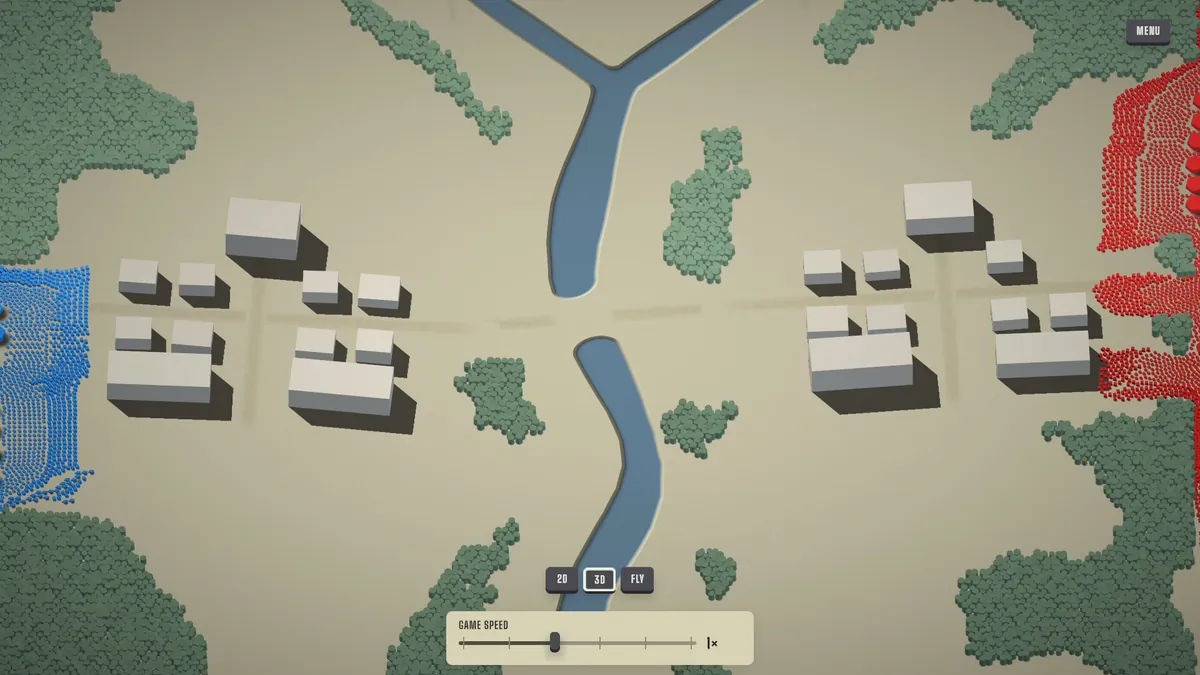
River crossing or bridge
The corridor does the work for you: the enemy can only come through a narrow front, so width stops mattering and depth becomes everything.
- Front: squares at the mouth of the bridge.
- Damage: triangles directly behind, able to hit whatever is stuck at the choke.
- Filler: rhombi, packed into any cell the corridor offers.
This is the one map type where rhombi are a core purchase rather than a specialist.
City streets
Buildings split the battlefield into lanes. You are effectively fighting several small battles at once, and a single big block cannot respond.
- Front: squares in each lane, one per street.
- Damage: triangles in the lane where the enemy is weakest.
- Filler: rhombi in the alley gaps.
The failure mode here is over-investing in one lane. If one lane collapses, the enemy walks into the flank of the others.
Composition by order
Your standing order changes the ideal shape of the army, not just its size.
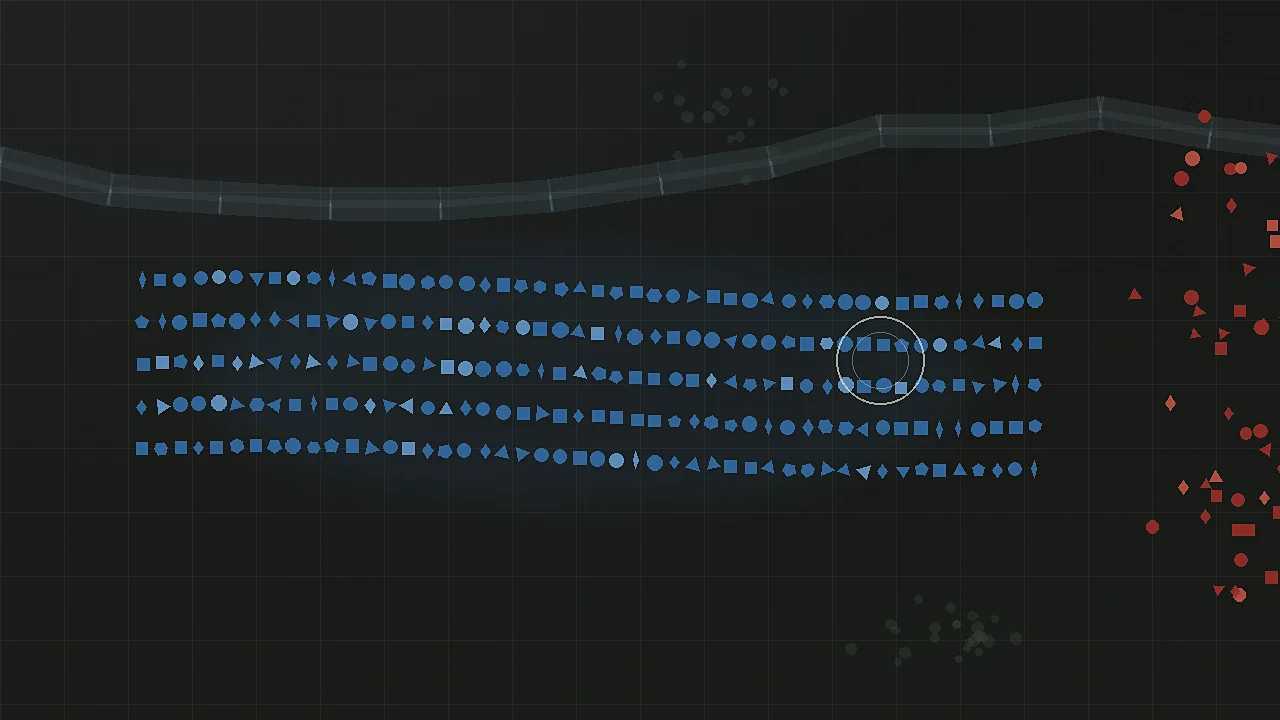
MARCH. The army moves forward, compresses, and hits with a narrower front than it started with. Build around a wedge: squares and circles as the body, triangles at the tip, minimal filler because you do not need to screen ground you are advancing across.
HOLD. The army stays put and the enemy comes to you. Build a concave arc: squares on both ends refused slightly forward, circles in the middle, triangles behind the centre where the enemy will bunch. Filler matters more here, because you have to cover a static line.
The single biggest composition error is painting a good HOLD army and then pressing MARCH. The formation and the order are one decision. Decide the order first, then paint for it.
When to break the ratios
Three situations justify abandoning a balanced army:
- You are massively outnumbered. Depth beats breadth. A deep circle block with a triangle core can beat a wider enemy by refusing to break in the centre.
- The level is timed. Filler is dead weight. Spend it on damage and accept a thinner line.
- The enemy is a single giant horde. Concentration wins. A narrow, deep formation that funnels the horde into a small contact area beats a wide line that gets eaten along its whole length.
The composition checklist
Before you press FIGHT:
- Does the front span the enemy's front, or will you be flanked?
- Is there damage behind the front, or is the whole army holding?
- Is the filler screening something, or is it just occupying cells?
- Does the shape of the army match MARCH or HOLD?
- If the level is timed, is anything in this formation not contributing?
Five questions, thirty seconds, and most composition errors disappear.
Official source: Steam store page ↗ — the description confirms that you paint troops onto the battlefield however you like and that battles are won by placing and commanding the army, not by unit micro.
Composition is a habit, not a formula
The ratios on this page are a scaffold for the first twenty levels. After that, you will start reading maps before you read guides: this level is a corridor, so rhombi; this one is open, so hexagons; this one is a boss, so depth. That reading skill is the actual progression in We March as One, and it is worth more than any fixed percentage.
Sources
- We March as One on Steam (official store page) ↗
- Steam Community discussions for We March as One ↗
- Steam user reviews for We March as One ↗
FAQ
What is a good unit ratio in We March as One?
Roughly 40% front, 35% damage, 25% filler for a standard campaign level. Shift toward the front on defensive levels and toward damage on timed ones.
Should my army be all one shape?
No. Single-shape armies stall as soon as the campaign introduces terrain that punishes them. Even a circle-heavy army wants a triangle core to finish fights.
How many ranks deep should a formation be?
Three ranks is the minimum for a line that survives first contact; five if the enemy has heavy units in the centre. More than five is usually wasted budget.
Does army composition matter in Tactics mode?
Yes, but you do not choose it — the army is fixed. In Tactics, composition becomes a placement puzzle instead of a buying decision.
Can I change composition mid-campaign?
Yes. Units are bought between levels, and the roster persists. You can pivot from a circle-heavy army to a triangle-heavy one as the campaign shifts toward city maps.