
Upgrade Tree: What to Buy First
How the branching upgrade tree works in We March as One, what each tier costs, and the buy order that gives the biggest campaign advantage per gold.
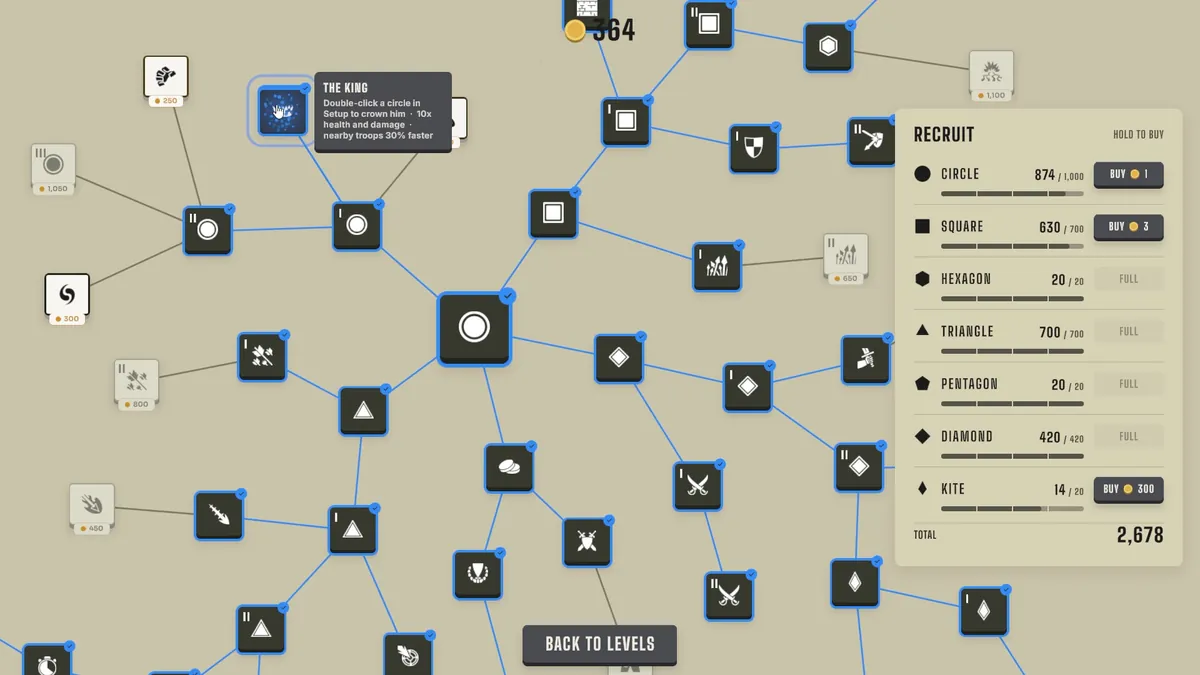
The UPGRADES panel in We March as One is a node graph, not a linear tech tree. Nodes are arranged in three tiers, they branch, and they cost gold that scales sharply as you go deeper. Nothing about the interface tells you which branch is worth opening first, and the game does not refund mistakes.
This page is about spending that gold well.
How the tree is structured
Three tiers of nodes, connected by lines. The pattern visible in the upgrade screen:
- Tier I nodes are the cheapest, starting around 250 gold. They are the broad foundation: small improvements that apply to most armies.
- Tier II nodes cost roughly 300 to 450 gold. This is where branches start to specialise — some nodes point toward specific shapes, others toward army-wide effects.
- Tier III nodes are the deep ones, up to around 1,050 gold. They are the payoffs at the end of a branch, including the one that turns a circle into The King.
Two structural facts matter more than any individual node:
- The tree is permanent. Once bought, a node stays bought for the campaign. You cannot respec.
- The tree is optional. You can finish the campaign without buying everything. Several experienced players deliberately skip parts of it to keep the game challenging.
Buying every node makes the campaign easier and shorter. If you enjoy the tactical layer, buying selectively — income and army size first, raw power later — keeps the mid-game interesting for longer.
The buy order that pays for itself
Think in terms of what a node returns, not what it costs.
First: economy and capacity. Nodes that increase your gold income or the size of the army you can field compound through every subsequent level. A 10% army increase bought at level 5 benefits forty-five more levels; the same node bought at level 40 benefits ten.
Second: the shapes you actually paint. If your army is circles and triangles, a node that improves squares is nearly dead gold. Look at your last five formations before spending.
Third: the King branch. Crowning a circle is the single largest power spike available in the tree, and it is worth planning a branch around. It is covered in detail on the King page→.
Last: everything else. Tier III nodes that do not support your army are the definition of gold you will never see again.
Reading a node before you buy it
The tooltip tells you three things: the cost, the effect, and — crucially — whether the effect is conditional. Conditional nodes are the ones that disappoint people.
A node that says something like "10x health and damage, nearby troops 30% faster" is unconditional once the condition of crowning is met. A node that only applies to a specific shape, or only in a specific mode, is worth much less unless you are committed to that shape or mode.
Before buying, ask:
- Does this affect the units I own now?
- Does it affect all of them, or only some?
- Will it still matter in ten levels?
Three yeses is an easy buy. Two is a maybe. One means you are buying flavour.
What the tree does not do
- It does not unlock modes. Campaign, Tactics, Command, Muster and Sandbox are separate; the tree is a Campaign progression system.
- It does not change unit roles. A buffed square still holds; a buffed triangle still breaks.
- It does not replace army size. A heavily upgraded small army still loses to a much larger one on an open map.
Sandbox perks are the same tree, without the climb
In Sandbox, the PERKS screen groups the same upgrades by shape and army, with the note that these are "the same perks as the upgrades screen, with no tree to climb". That makes Sandbox the best place to test whether a node is worth buying: apply it for free, run a battle, and see the difference before spending campaign gold.
This is genuinely useful and most players never do it. Ten minutes in Sandbox can save a thousand gold in Campaign.
When to buy everything
There are two achievements tied to completion of the tree:
- Studied — upgrade half of the skill tree.
- Every Last Leaf — upgrade every node.
Every Last Leaf sits below 7% of players, which tells you something: most people finish the campaign without completing the tree. If you are chasing 100%, the tree is one of the last things you finish, not a mid-game priority.
Official source: Steam global achievement stats ↗ — Studied (half the tree) is unlocked by roughly one in five players, while Every Last Leaf (the whole tree) sits under 7%.
A short version you can act on
If you remember nothing else: buy income and army size first, buy only the branches that match the shapes you paint, plan a path to the King, and test expensive nodes in Sandbox before paying for them. That is the tree solved.
Sources
- We March as One on Steam (official store page) ↗
- Steam global achievement stats for We March as One ↗
- Steam Community discussions for We March as One ↗
FAQ
Can I respec the upgrade tree?
No. Upgrades are permanent for the campaign, which is why the buy order matters.
How much does the whole tree cost?
The cheapest nodes start around 250 gold and the deepest around 1,050, so completing it is a campaign-long project rather than something you finish in the first act.
Do I need to complete the tree to finish the campaign?
No. Most players finish level 50 without every node, and the completion achievements for the tree sit well below the achievement for finishing the campaign.
Does the tree carry into other modes?
The Sandbox perks screen offers the same effects without the tree, but the Campaign tree itself is a Campaign progression system.
What is the best first upgrade?
Whatever increases your income or the number of units you can field. Those compound; raw combat stats do not.