
Gold Economy: Earning and Spending
How gold works in We March as One: what pays out after a battle, how ratings boost income, and the spending order that keeps your army growing.
We March as One is an incremental strategy game, which means the economy is not a side system — it is the progression. Gold buys units and upgrades, units and upgrades win levels, levels pay gold. Break the loop and the campaign stalls.
The good news is that the loop is generous. You get paid for losing. That single design decision means there is no dead end, only a slower path.
For what to buy first, see the upgrade tree→; for how a single battle earns its pay, see the beginner guide→.
Where gold comes from
Three sources, in order of importance:
- Battle payouts. Every battle pays gold, win or lose. Wins pay more, and higher ratings pay bonuses on top.
- Rating bonuses. DECISIVE and HEROIC ratings are the game's difficulty valve: replaying a level you already beat for a better rating is often the fastest gold in the game.
- First clears. New levels pay for the first completion, which is why pushing forward and then going back to clean up is a legitimate strategy.
What does not pay gold: time spent in Setup, units left unpainted, or losses taken. There is no reward for efficiency during a battle beyond the rating it produces.
If a new level feels impossible, the answer is usually two replays of the previous level for a better rating, not a better plan. Ratings are income. Income is army. Army is progress.
The rating bonus is the real economy
The ratings are not just bragging rights. A DECISIVE or HEROIC clear pays meaningfully more than a bare win, and the difference compounds across a campaign.
That makes the optimal loop:
- Push into a new level to see what it demands.
- If you win, replay it once for a better rating while the formation is fresh.
- If you lose, replay an older level you can reliably rate highly, then return.
The Mastered achievement — getting DECISIVE and HEROIC on the same level — is the formal version of this habit, and roughly seven in ten players have it. If you are short on gold, that achievement is a blueprint.
The spending order
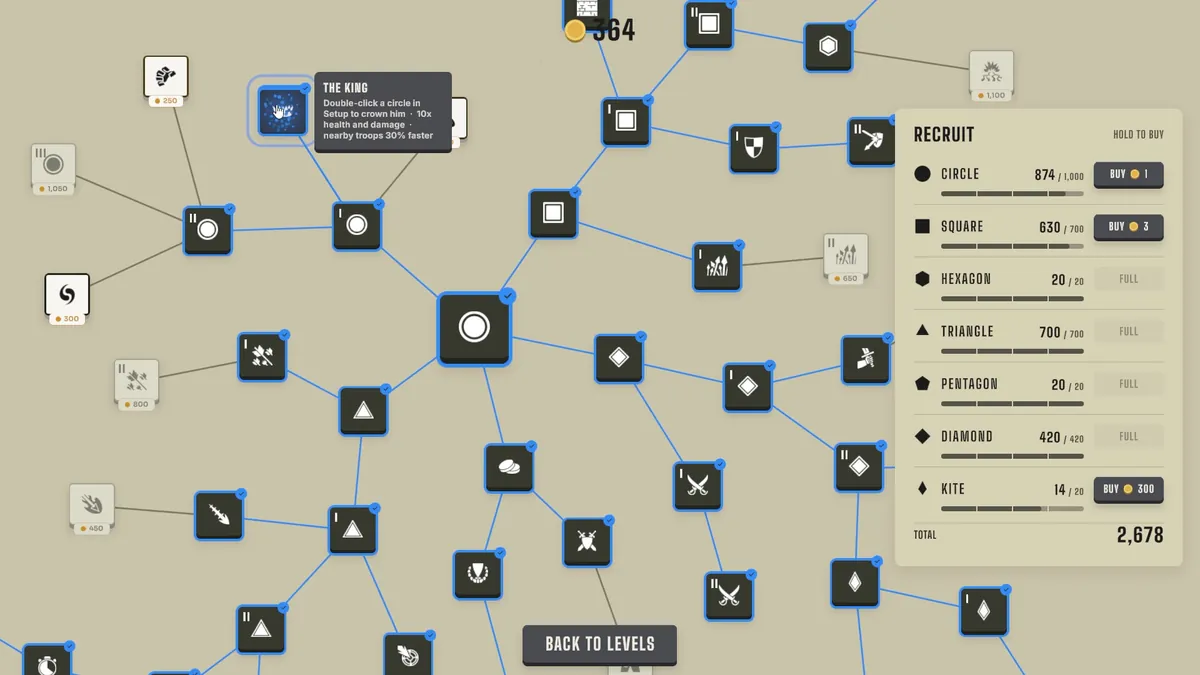
Gold has two sinks: units and permanent upgrades. Spending it in the wrong order is the most common way to make the campaign harder than it needs to be.
Buy units first, in this order:
- Depth for your main shape. More circles means a deeper block, which means surviving the first exchange.
- One damage shape. Triangles, enough to form a core behind the front.
- One anchor shape. Squares, enough to hold both ends of a line.
Then buy upgrades, in this order:
- Nodes that increase the size of your army or the gold you earn.
- Nodes that unlock or improve the shape you actually use.
- Everything else.
The trap is buying a specialist unit before you have the depth to support it. A single expensive unit in a shallow line dies alone.
When to stop buying units
There is a point in every campaign where more units stop helping, because the level's budget cap or the front width limits how many you can paint. Recognise it by these signs:
- You are finishing levels with units still unpainted in the palette.
- Your formation is already at the width the map allows.
- New levels are failing on placement, not on numbers.
At that point, gold belongs in upgrades, not recruitment.
A unit purchase can be adapted to any future level by painting it differently. An upgrade is a fixed commitment. When gold is tight and you are unsure what the next act looks like, buy units.
Gold in the other modes
- Campaign: the only mode with a persistent economy. Gold carries between levels.
- Muster: a fixed budget per battle. You draft an army to a cost cap, and gold earned in the battle does not carry into the campaign.
- Tactics: no economy at all. Fixed army, fixed board.
- Command: uses the campaign army, with in-battle powers that spend battle resources rather than campaign gold.
- Sandbox: no economy. You set the budgets yourself.
If you are grinding for gold, you are in Campaign. Nothing else contributes.
Official source: We March as One on Steam ↗ — the official description states that defeating enemies earns gold whether you win or lose, and that gold recruits more troops and unlocks unit types in a branching tree.
The economy in one paragraph
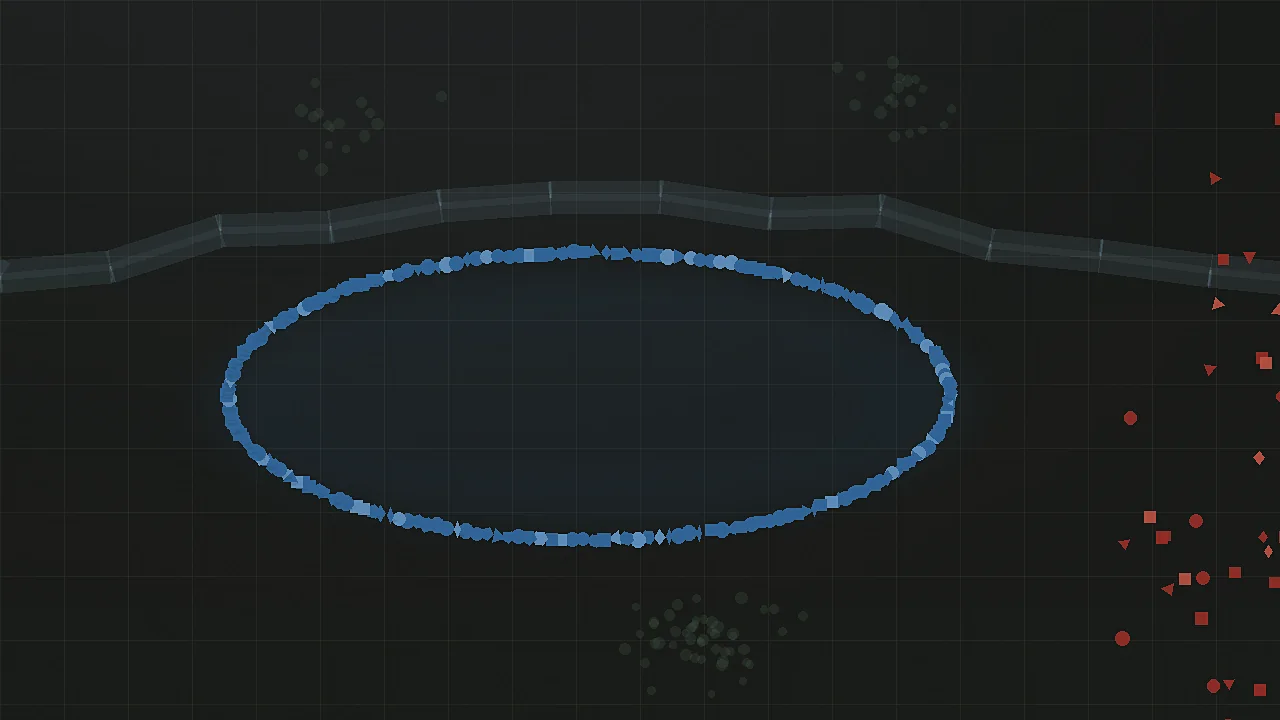
Gold comes from battles, and the biggest lever on battle income is the rating you earn, not the number of battles you fight. Spend early gold on depth for your main shape, then on one damage shape, then on upgrades that increase income or army size. Replay for ratings whenever progress stalls. That loop will carry you to level 50 without ever needing to grind a level you hate.
Sources
- We March as One on Steam (official store page) ↗
- Steam Community discussions for We March as One ↗
- Steam global achievement stats for We March as One ↗
FAQ
Do you get gold for losing?
Yes. Defeating enemies earns gold whether the battle is won or lost, which is why a failed attempt still advances your army.
What pays the most gold?
A high rating on a winnable level. Replaying an old level for DECISIVE or HEROIC is usually more efficient than grinding a new level you barely win.
Should I save gold or spend it?
Spend it. Gold does nothing while it sits, and units bought earlier compound through every subsequent level.
Do upgrades cost gold or something else?
Gold, in increasing amounts by tier. The deepest nodes cost over a thousand gold each, so the tree is a long-term sink rather than an early purchase.
Is there any way to lose gold?
No. There is no upkeep, no penalty for losing, and no way to spend gold on something that disappears. Every purchase is permanent.