
All Seven Shapes: Unit Roles Explained
Every unit type in We March as One explained: circles, squares, triangles, diamonds, pentagons, hexagons and rhombi, and where each belongs.
We March as One has exactly seven unit types, and they are all geometric shapes: a circle, a square, a triangle, a diamond, a pentagon, a hexagon and a rhombus. There are no names, no class labels and no stat screen. The shape is the entire identity, and the game expects you to learn what each one does by watching it fight.
That is a design choice, not an oversight — the developer has said the units are meant to read at a glance. It also means every guide that gives you a spreadsheet of HP values is making those numbers up. What follows is the qualitative role of each shape, based on the official material, the in-game palette and what players report after finishing the campaign.
Circles — the body of the army
Circles are the first unit you own and the one you will own most of. They are the baseline against which every other shape is measured, and the only shape that can become The King.
- Role: line infantry. Fill the front, absorb the first exchange, keep the formation coherent.
- Strength: cheap, plentiful, and the target of the King's aura.
- Weakness: no answer to anything. A circle-only army loses to concentrated damage and to anything that outranges it.
- Where to paint: the centre and the front rank of a block, in depth.
Because the King must be a circle, circles stay relevant for the whole campaign even after better damage dealers appear. A crowned circle in the middle of a circle block is the default backbone of most armies.
Squares — the wall
Squares read as the heavy infantry of the game: slower, sturdier, and better at holding a position than at taking one.
- Role: anchor. Hold a flank, plug a bridge, absorb a charge.
- Strength: survives long enough for the rest of the line to reposition behind it.
- Weakness: low damage output for the cost. A square-heavy army wins slowly, which matters when a wave timer is running.
- Where to paint: the two ends of a line, or the mouth of a choke point.
If a level keeps collapsing on one flank, squares on that flank is usually the cheapest fix.
Triangles — the point of the spear
Triangles are the aggressive shape. They concentrate damage into a narrow front, which makes them the natural tip of a wedge.
- Role: breaker. Punch a hole in a line, delete a high-value target, open a flank.
- Strength: the best shape for converting a local numbers advantage into a rout.
- Weakness: fragile in a long grind. A triangle that does not break through quickly becomes a hole in your own line.
- Where to paint: the tip of a MARCH wedge, or the inside corner of a HOLD arc where the enemy will bunch up.
Diamonds — the filler
Diamonds sit between circles and triangles. They are not the best at anything, which makes them the most flexible shape in the palette.
- Role: connector. Fill the gap between a solid block and a pointed attack without weakening either.
- Strength: cheap enough to paint in bulk, sharp enough to contribute to a push.
- Weakness: no speciality means no solution. Diamonds never fix a problem on their own.
- Where to paint: the shoulders of a wedge, the seam between two blocks, and any cell where a circle feels too soft and a triangle too fragile.
Pentagons — the flank weight
Pentagons are heavier pieces. They are the shape you paint when a flank needs to survive on its own without support.
- Role: flank anchor and independent operator.
- Strength: enough staying power to hold a side lane while the main army fights elsewhere.
- Weakness: expensive per unit; a pentagon line is a commitment.
- Where to paint: the outside edge of a wide formation, or a secondary lane the enemy is trying to turn.
Hexagons — the screen
Hexagons cover more ground per unit than the round shapes, which makes them natural screeners: they occupy space, block movement and soak attention.
- Role: screen and area denial.
- Strength: wide coverage for the cost, which makes them efficient on open maps.
- Weakness: a screen without a damage line behind it is just a delay.
- Where to paint: in front of your damage dealers, across open ground where the enemy has room to flank.
Rhombi — the corridor specialists
Rhombi are the thin sliver shape. Narrow, cheap, and built for spaces where nothing else fits.
- Role: corridor filler and cheap coverage.
- Strength: you can paint a lot of them into a bridge, a gate or a gap between buildings.
- Weakness: thin bodies lose one-on-one trades; never use them as a main line on open ground.
- Where to paint: choke points, wall gaps, and the inside of a city street.
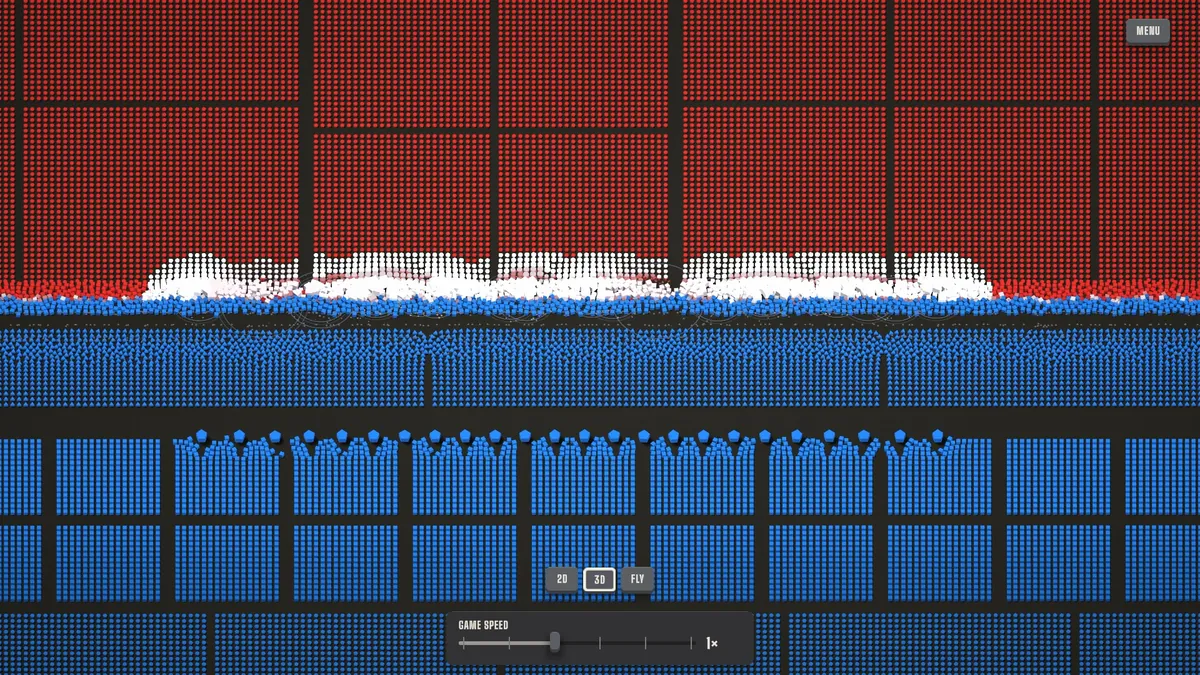
How the shapes combine
The game rewards mixing because each shape covers another's weakness. Three combinations that show up again and again in successful campaign armies:
| Combination | What it solves |
|---|---|
| Squares in front, circles behind, triangles on one flank | A straight fight against a wider enemy line |
| Hexagon screen, triangle wedge behind it | Open ground where the enemy can flank |
| Rhombi in a corridor, pentagons at the exit | Bridge, gate and city-street levels |
The pattern is always the same: something holds, something hits, something fills. The army composition guide→ turns that into ratios you can paint.
There is no damage or health readout on units, and players have asked for one in the Steam discussions without getting it. That means matchup knowledge has to come from watching fights, not from datamining. Treat any exact stat table you see online as an estimate.
Official source: We March as One on Steam ↗ — the store page describes recruiting more troops and unlocking new unit types through a branching upgrade tree.
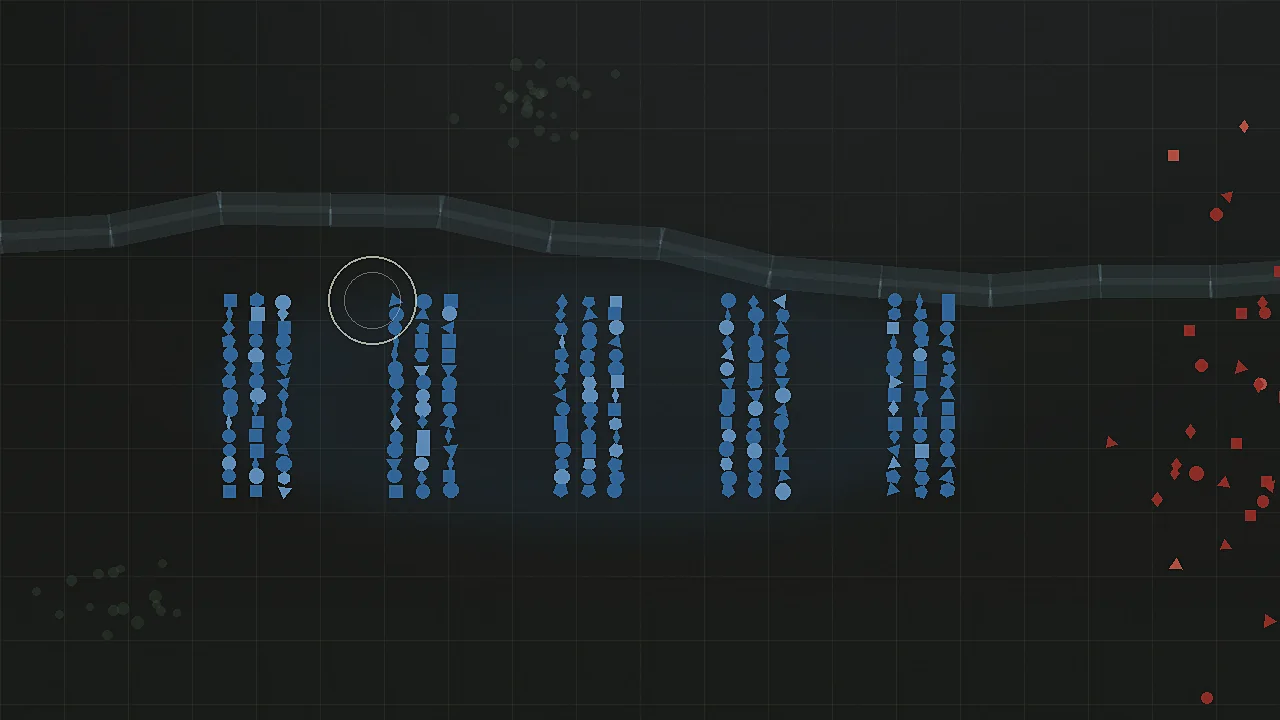
Which shape should you unlock first?
If you are choosing what to spend early gold on, the order that causes the fewest regrets is:
- More circles — the King needs a bodyguard, and circles are the cheapest depth you can buy.
- Triangles — the first shape that lets you break a line instead of leaning on it.
- Squares — the first shape that lets you stop losing a flank.
- Diamonds or hexagons — whichever matches the maps you are currently stuck on.
- Pentagons and rhombi — specialists, bought when a specific level demands them.
That order is not a tier list. It is a list of problems in the order the campaign presents them. The unit tier list→ ranks the shapes for raw campaign value if you want the blunt version.
Sources
- We March as One on Steam (official store page) ↗
- Steam global achievement stats for We March as One ↗
- Steam Community discussions for We March as One ↗
FAQ
How many unit types are in We March as One?
Seven: circles, squares, triangles, diamonds, pentagons, hexagons and rhombi. The full game roughly doubles the unit count compared with the demo, according to player reports.
Which unit is the strongest?
There is no single strongest unit, because the game does not publish stats and every shape counters something. Triangles deal the most concentrated damage; squares survive the longest; circles are the only ones that can be crowned.
Can I unlock units out of order?
The upgrade tree is branching, so yes — you choose which branches to open. The practical constraint is gold, not a fixed tech order.
Do unit types have different costs?
Yes. Heavier shapes cost more gold per unit than circles, which is why a pentagon line is a real commitment and a circle block is the default.
Why can only circles become the King?
That is the rule the game enforces: double-clicking a circle in Setup crowns it. No other shape can be crowned.