
Best Units in We March as One
The best unit for each job in We March as One: holding a line, breaking one, screening open ground, and holding a corridor, with picks by level type.
"Best unit" is the wrong question in We March as One, because the game has no single stat line to optimise and no shape that wins every map. The right question is narrower and much more useful: what is the best unit for the job this level is asking me to do?
There are only four jobs. Learn which shape wins each one and you can stop looking for a ranking.
Best unit for holding a line: Squares
Squares are the shape that stays put. They do not kill quickly, but they do not fold either, which is the entire point of a holding unit.
Use squares when:
- A level has a fixed defensive line you must not lose.
- One flank keeps collapsing while the other holds.
- You are fighting in front of a choke point and need something to absorb the first wave.
The cost is tempo. A square-anchored line wins slowly, and slow is a loss on timed levels. Paint squares where you need the line to exist, not everywhere.
Best unit for breaking a line: Triangles
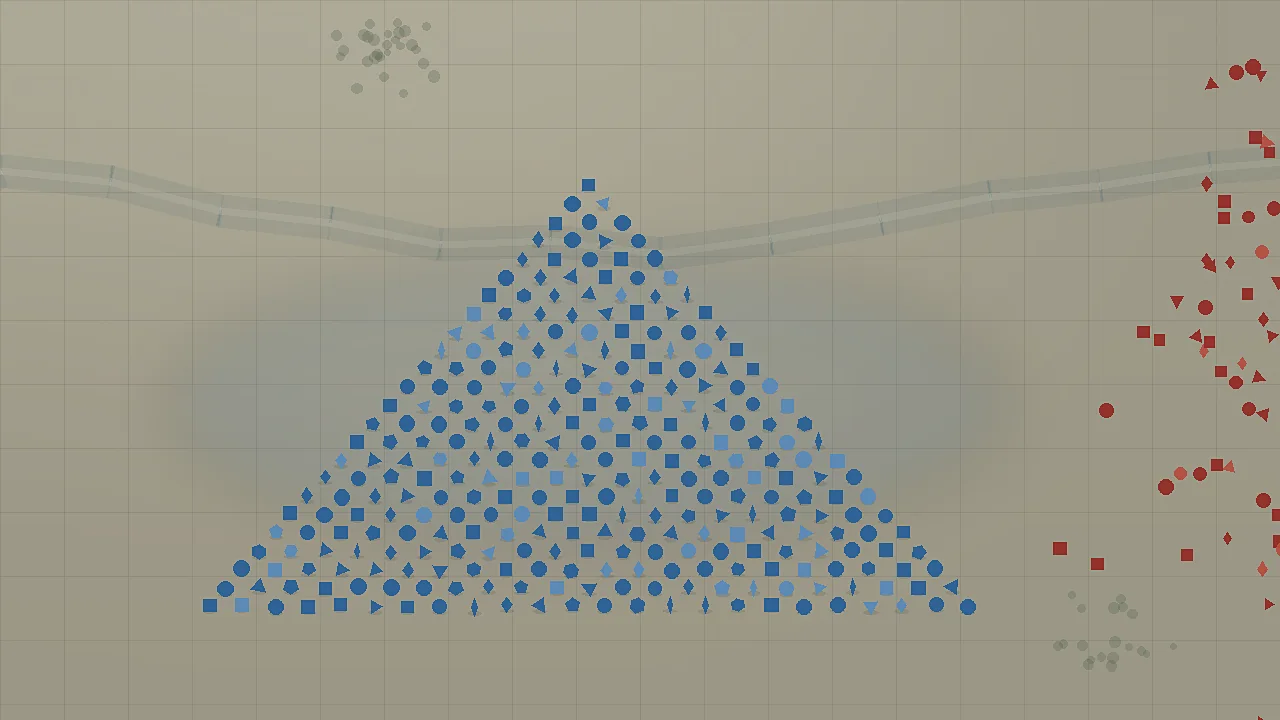
Attack in this game is about concentration. Triangles put the most bodies into the smallest front, which is exactly what you need to open a hole.
Use triangles when:
- You outnumber the enemy locally and need to convert it.
- The enemy line is thin somewhere — a refused flank, a gap between buildings.
- You are behind on time and need a rout rather than a grind.
Triangles are the most common reason a losing level suddenly becomes winnable, and the most common reason a winning formation collapses: paint them where they can break through, not where they will be surrounded.
A triangle front rank trades badly against anything solid. Put circles or squares in front and let triangles arrive second, into a line that is already engaged.
Best unit for open ground: Hexagons
Open maps are width problems. The enemy can go around you, and a narrow army gets flanked no matter how strong it is.
Hexagons cover more ground per unit than the round shapes, which makes them the cheapest way to screen a wide front. Paint a hexagon screen, put your damage behind it, and the enemy's flanking route closes.
Hexagons are wasted in corridors. If the map is a bridge or a street, skip them.
Best unit for corridors and city streets: Rhombi
In a gate, on a bridge, or in a city street, the number of cells you can occupy is small. Rhombi are thin and cheap, which means you can pack a lot of bodies into a narrow space.
The corollary is the important part: rhombi on open ground are the worst purchase in the game. Their value is entirely situational.
Best unit overall: Circles
Circles win the "best overall" category for three unglamorous reasons:
- They are the cheapest depth. Every formation needs a second and third rank, and circles fill it at the lowest cost.
- They can be crowned. The King is a circle, gets 10x health and damage, and gives nearby troops a 30% speed aura. That makes a circle block the best place to put your single strongest unit.
- They never stop being useful. Diamonds become redundant once you own triangles. Circles never do.
The unit tier list→ places circles in S tier for the same reasons.
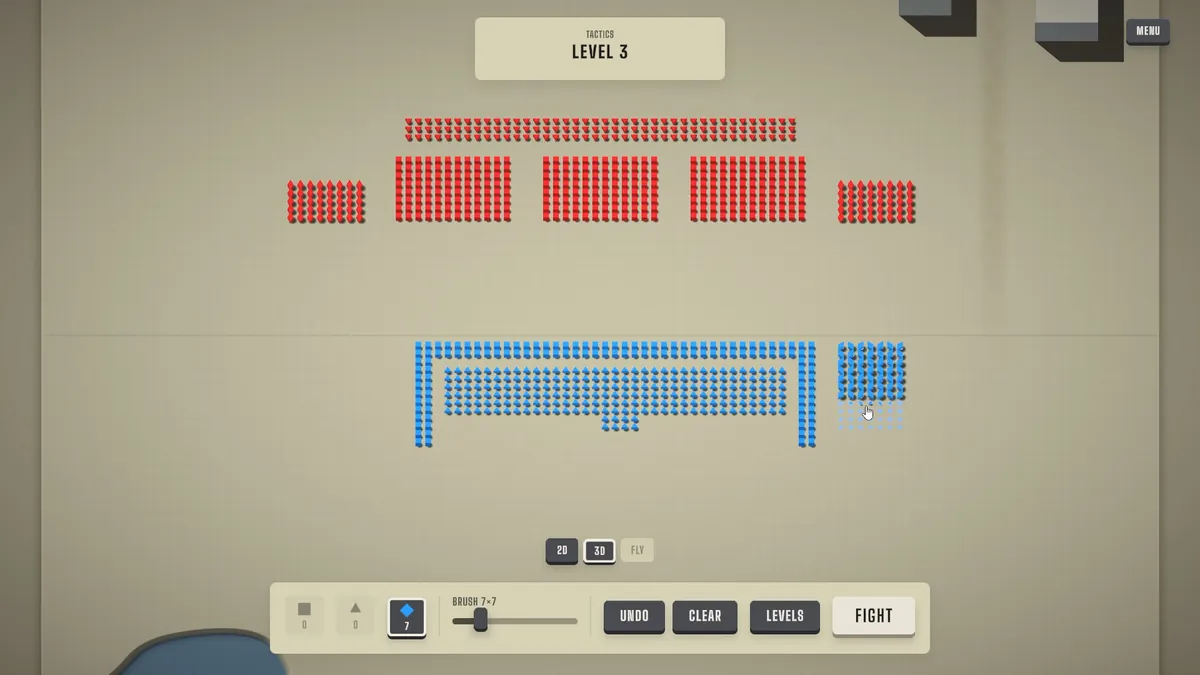
Best unit by level archetype
| Level archetype | Best pick | Why |
|---|---|---|
| Open field, enemy wider than you | Hexagons + circles | Screen the flanks, hold the centre |
| Open field, you are wider | Triangles + circles | Concentrate and break before they reform |
| Bridge or river crossing | Rhombi + squares | Pack the corridor, anchor the exit |
| City street with buildings | Rhombi + triangles | Corridor filler plus a breakthrough tip |
| Defensive hold | Squares + circles | Absorb, then counter with depth |
| Timed assault | Triangles + diamonds | Speed over durability |
| Boss or giant horde wave | Circles + triangles | Depth to survive, concentration to kill |
What "best" does not mean
Three traps in the way people talk about units in this game:
- Best damage is not best unit. Triangles deal the most concentrated damage and still lose levels when they are the whole army.
- Best unit is not the most expensive. Pentagons are strong and frequently a worse purchase than two squares and a rank of circles.
- Best unit is not permanent. The shape that solves act one is not the shape that solves the city levels.
There is no sell mechanic. Every specialist you buy early is gold you did not spend on depth. Buy the shape when a level makes you wish you had it.
Official source: We March as One on Steam ↗ — the store page confirms that new unit types are unlocked through a branching upgrade tree, and that the army carries between battles.
The one-line answer
If someone asks you which unit is best and will not accept a paragraph: circles for the body, triangles for the answer, squares for the insurance, hexagons for open ground, rhombi for corridors, diamonds and pentagons when you have gold to spare.
Sources
- We March as One on Steam (official store page) ↗
- Steam global achievement stats for We March as One ↗
- Steam Community discussions for We March as One ↗
FAQ
What is the strongest unit in We March as One?
By raw individual power, the crowned King — a circle with 10x health and damage. By value per gold across a campaign, circles as a class.
Are triangles the best damage unit?
They are the best at concentrating damage into a narrow front, which is what breaking a line requires. They are not the best at surviving, so they need something in front of them.
Is there a unit that wins every level?
No. The campaign deliberately changes map shape — open fields, rivers, city streets — so that no single formation works everywhere.
Should I buy pentagons?
Only when a level has an independent side lane that needs to survive without support. Otherwise squares plus depth is cheaper and nearly as good.
Do unit upgrades change which unit is best?
They can shift the ranking slightly, but they do not change roles. A buffed square is still a holder, not a breaker.