
We March as One Wiki: Game Overview
We March as One at a glance: release date, price, the seven shapes, the five modes, and what the 50-level campaign actually asks of you.
We March as One is a minimalist strategy game about turning a handful of geometric shapes into an army of tens of thousands, painting that army onto a battlefield with a brush, and then watching the simulation decide whether your formation was clever or just expensive. It is a one-person project by dux, it costs less than a sandwich, and it hides a surprising amount of positioning work under a very plain interface.
This overview page is the hub: what the game is, what each mode expects, and which guide to open first depending on what you are stuck on.
The short version
| Fact | Detail |
|---|---|
| Developer / publisher | dux |
| Release date | 13 November 2026 (Steam, PC) |
| Price | $7.99, often listed against a $9.99 base |
| Genre tags | Indie, Simulation, Strategy — plus Incremental Strategy, Auto Battler, Tower Defense, Wargame |
| Players | Single-player only |
| Campaign length | 50 levels, roughly 10 hours for full completion according to player reports |
| Completion systems | 30 Steam achievements, DECISIVE and HEROIC ratings per level |
| Extras | Steam Cloud, Family Sharing, level editor in Sandbox, free demo |
The core loop in four sentences
You start each battle with a fixed pool of gold and a palette of seven shape types. You paint those shapes onto your half of the map, spend leftover gold on permanent upgrades, then choose MARCH or HOLD and press FIGHT. The battle resolves as a full simulation — every soldier and every projectile is tracked individually — and you keep your army between levels, so a loss is a setback rather than a reset. Whatever happens, you earn gold, which buys more units and more upgrades for the next fight.
That last point is the design decision that shapes everything else. Because gold flows in even when you lose, the game is forgiving in a way that traditional tactics games are not. You can brute-force a level with a bigger army next time. The catch is that brute force gets expensive, and the levels that punish it are exactly the ones people get stuck on.
The game is incremental in its economy, not in its combat. Your army grows across levels and your upgrade tree compounds, but each individual battle is still a placement puzzle. Players who treat it as pure number-go-up tend to hit a wall around the city levels.
The seven shapes
Every unit in the game is a shape, and the shape tells you what to expect from it:
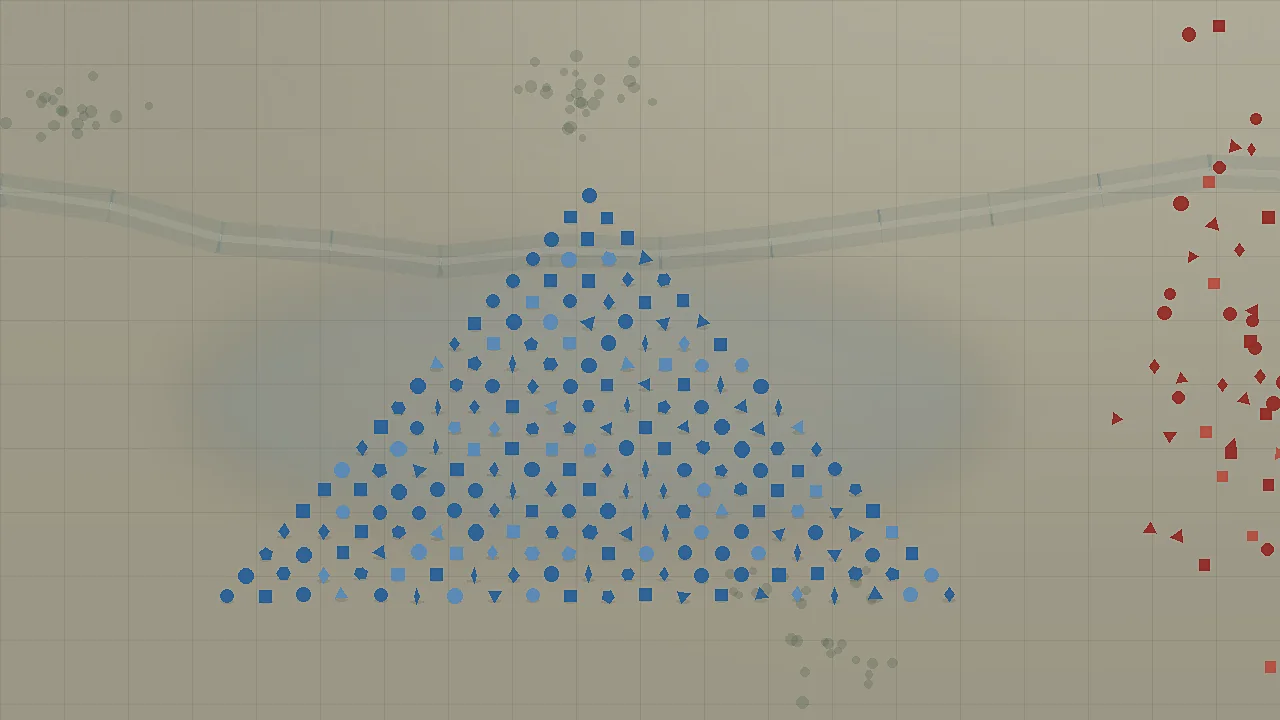
- Circles — the default body of the army, and the only shape that can be crowned as The King.
- Squares — slow, sturdy blocks that hold ground and absorb a push.
- Triangles — pointed, aggressive, best used where you want damage concentrated.
- Diamonds — the in-between shape that fills gaps in a line without softening it.
- Pentagons — heavier pieces that anchor a flank rather than a centre.
- Hexagons — wide bodies that cover more ground per unit and suit screening roles.
- Rhombi — the thin sliver shape, useful for narrow corridors and cheap coverage.
The full breakdown, including how each one behaves in a grind, is in the unit roles guide→. If you only read one page before your first session, read the beginner route instead — it tells you which three shapes to actually buy.
The five modes
We March as One is not one game but five variations on the same rules:
- Campaign — 50 levels, persistent army, gold carries forward. This is the main mode and the one most players spend their time in.
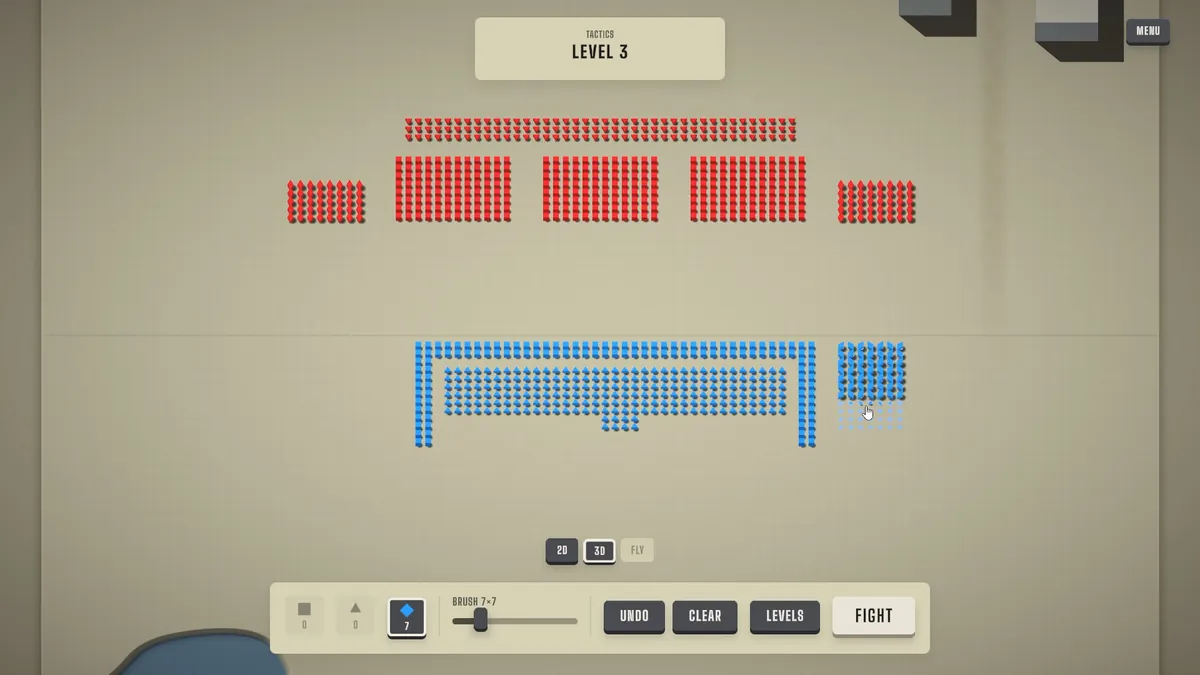
- Tactics — fixed army, no recruiting. Placement and orders decide everything, which makes it the purest puzzle mode.
- Command — real-time orders and battlefield powers during the fight, rather than a pre-battle plan.
- Muster — a fixed budget and a draft. You build the best army you can from limited resources.
- Sandbox — custom levels, custom armies, and a full level editor. Units and upgrades you have met in other modes unlock here.
Each mode gets its own guide on this site, because the habits that win a campaign level are not always the habits that win a Tactics board.
How hard is it, really?
The first ten levels are gentle. You are mostly painting lines of circles and watching them win. The difficulty curve steepens once the game starts giving you multiple unit types and expects you to combine them — the Combined Arms achievement, for winning a campaign battle with at least five unit types, is currently unlocked by about half of all players, which tells you where the real tutorial ends.
Two structural things keep the game from becoming a wall:
- Losses still pay. You get gold from a defeat, so a failed level is progress toward a bigger army.
- Ratings are optional. Finishing a level is one thing; earning DECISIVE or HEROIC on it is another. You can push the campaign forward and come back for ratings later.
Two things make it harder than it looks:
- No stat readout. The game does not show HP or damage numbers on units, so you learn matchups by watching, not by reading a spreadsheet.
- Auto-targeting. Troops pick the nearest enemy rather than obeying a detailed command system, so the shape of your formation decides who fights whom.
Several long-time players deliberately skip parts of the upgrade tree to keep levels challenging. Upgrades are permanent and cannot be refunded, and an over-upgraded army can flatten the early campaign in a way that removes the puzzle. Buy what solves your current problem, not the whole tree.
Official source: We March as One on Steam ↗ — store description, release date, price and feature list, retrieved 14 November 2026.
Is it worth playing in 2026?
At $7.99 the game is easy to recommend if you like the idea of a tactics game that respects your time: levels are short, retries are cheap, and the army you build persists. The Steam user score sits at 100% positive from the first couple of days of reviews, which is a small sample but a consistent one — the complaints in the community hub are about scope and interface polish, not about the core loop being broken.
If you bounce off it, the usual reason is the incremental layer. Players who want a tight, hand-designed puzzle campaign sometimes find the "just buy more units" escape hatch unsatisfying. Players who like watching a plan collapse in real time, then fixing it with a better formation, tend to stay.
FAQ
Is We March as One a tower defense game?
Partly. It borrows wave defence and choke-point grinding from tower defense, but you are moving an army rather than placing fixed towers. The Steam tags list both Tower Defense and Auto Battler, and neither is fully accurate on its own.
Does it have multiplayer?
No. It is a single-player game with Steam Cloud and Family Sharing, and there is no versus or co-op mode.
How long is the campaign?
There are 50 levels. Players reporting full completion put it at roughly ten hours, with more time if you go back for every DECISIVE and HEROIC rating.
Is there a demo?
Yes. A free demo is available as a separate Steam app, and progress in it is separate from the full game.
Does it run on Steam Deck?
The store page lists Windows as the platform. Community threads mention cloud play through GeForce NOW rather than a verified Steam Deck build, so check the current store compatibility badge before buying for handheld play.
Sources
- Steam store page ↗ — official description, price, tags, release date
- Steam global achievement stats ↗ — unlock percentages used on this page
- Steam community discussions ↗ — player reports on difficulty and upgrades
- Steam user reviews ↗ — completion time and campaign length reports